
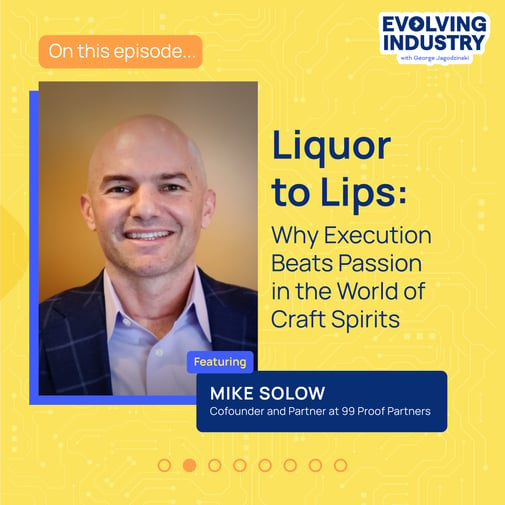
Liquor to Lips: Why Execution Beats Passion in the World of Craft Spirits
Is passion enough to turn a crazy dream into a scalable business?
Mike Solow, Cofounder and Partner at 99 Proof Partners, believes that while craftsmanship and pride drive the initial spark of a spirit brand, the path to long-term survival is paved with pragmatic execution.
With years of experience advising hundreds of founders, Mike has seen how the romance of the industry often clashes with the harsh realities of profitability and market corrections.
Mike joined us to explore:
- Why founders must become students of profitability
- The danger of the “most beautiful baby” syndrome
- Why the spirits industry is still operating in a draconian tech era
The Chasm Between Passion and Profit
Mike observed that many aspiring distillers enter the market with a passionate dream, but few possess the stamina to bridge the initial gap to sustainability.
He highlighted that while the spirits sector is filled with prideful craftsmanship, it is a sector currently facing a significant market correction that punishes the smallest players.
“A penny’s worth of free advice to anybody [who’s] thinking about jumping off and doing this is to really become a student of profitability,” Mike told our host, George Jagodzinski. “Understand those risk factors so you can set yourself up to be sustainable for a while without having to go out and raise enormous amounts of capital in order to stay in business.”
For Mike, the primary goal shouldn’t be a billion-dollar exit, but building a serviceable, scalable business where execution risk is managed through research and smart partnerships.
Divorcing Ego from the Liquid
One of the most common pitfalls for founders is a refusal to accept critical feedback because they are too emotionally invested in their product.
Mike noted that even highly competent master distillers can bottom out their businesses by spending too much capital on hand-forging stills or chasing perfection at the expense of time.
“Almost all of them will tell you, ‘My liquid’s the best liquid,’ or some version of that,” Mike explained. “But then, they go out and maybe get silver instead of gold at some award [show]. And so, they start to get their nose bloodied a little bit.”
He argued that real success requires a fast pivot into a category that’s appropriate to their aptitude.
“Being able to really take a step back and hear what the market is telling you... [is] a hard lesson to learn sometimes,” Mike said.
Those who succeed learn to “lean into where they are,” finding a place for their product that isn’t marked at a premium.
“Not everybody is going to buy a two or $300 bottle of tequila or bourbon,” Mike noted. “They’re going to have a daily drinker. They’re going to have something that’s $40 [or] 50, and they’re going to feel great about drinking that.”
The Draconian Tech Frontier
While software industries move at lightning speed, the spirits world is often stuck in a technological time warp.
Mike finds the disparity staggering, noting that much of the industry still relies on manual processes.
“In many ways, beverage-alcohol is still run, from a technology standpoint, like it’s draconian,” he suggested. “Realistically, when you compare it to [the tech field], this could feel like 1989, maybe 1990.”
From distributors using clipboards and pencils to massive data lags in warehouses, Mike sees this as a massive opportunity for tech-savvy founders.
He suggested that the next wave of disruption won't just come from the liquid inside the bottle, but from the software that manages sales territories, logistics, and supply chains.
However, he packaged some words of caution with his encouragement to potential founders.
“Sky’s the limit, man. Go invent something,” Solow encouraged. “[But] if you do want to start your own company… you have to be good at raising money.”
Ultimately, Solow believes that long-term success in spirits requires a clear-eyed vision and the discipline to protect your most valuable asset: time.
The core philosophy of Solow's approach can be found in the advice he received from his own mentor:
“You have to be able to distill down the opportunities that are a good fit for you, that are a good use of your time, and are going to do the things you want them to do for your family, for your legacy.”
Craving more? You can find this interview and many more by subscribing to Evolving Industry on Apple Podcasts, on Spotify, or here.