
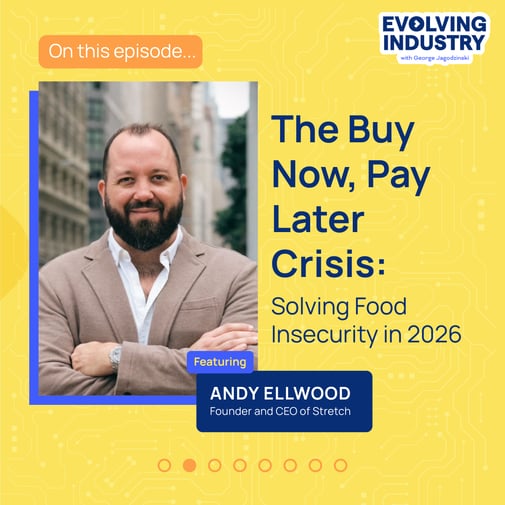
The Buy Now, Pay Later Crisis: Solving Food Insecurity in 2026
Is the grocery industry stuck in the past?
Andy Ellwood, Founder and CEO of Stretch, believes the core framework of how we buy food hasn’t fundamentally changed since the Roman Empire.
For centuries, shoppers have rolled up to local marketplaces hoping the stalls carried what they needed at a fair price, but they’ve never truly had the data to verify it.
The veteran founder helped us explore the transition from information asymmetry to a world where AI finally puts the power back into the shopper’s hands.
Andy talked with us about:
- Why the grocery industry is built on a 2,000-year-old model
- The heartbreaking reality of modern food insecurity
- How AI is helping Andy map “shopper intent” across 550,000 unique SKUs
The Roman Empire Problem
Andy observed that while almost every other major industry has embraced pricing transparency, groceries remain the final frontier.
“Expedia made it seem crazy to buy a $500 flight without comparing prices,” he argued. “We want to make it seem crazy that you spent $7,000 this year on groceries without comparing prices.”
Customers have more options than ever before.
Yet even with seven different stores within a three-mile radius, most families still gravitate toward one without knowing if it actually carries the products they need at the right price.
“This goes back to the Roman Empire,” he explained. “You’d roll up to your local marketplace and hope that the stalls were carrying food that you wanted and you hoped that they would charge you a good price. But you’re not going to four different markets... checking prices”.
But today, grocery stores know significantly more about the shopper than the shopper knows about the marketplace.
To solve this, Andy points out that we must confront the information asymmetry currently ruling the aisles.
The Reality of 2026: Skipping Meals to Feed Families
While the tech world often focuses on convenience, Andy is focused on survival.
In a survey of over 1,000 families, the data revealed a staggering shift in consumer behavior driven by prices that rose during the pandemic and never came back down.
“The biggest shift in grocery behavior was not happening in the blue collar and low-income families,” Andy shared. “It was happening in the middle and upper income families because grocery prices have gotten so outrageous.
Even more alarming is the dark side of this economic pressure.
17% of the surveyed shoppers admitted to skipping a meal in the past two months just to ensure another family member could eat.
With grocery costs now exceeding car payments and electricity bills for many households, the use of “Buy Now, Pay Later” services for food has become a common, yet desperate, reality.
“84% of [families] said that they weren't sure they were going to be able to afford groceries next month the way that they paid for them this month,” Andy told our host, George Jagodzinski.
AI and the Shopping Intention Map
A major reason it has taken over a decade for Andy to bring this vision to life is the sheer complexity of the data.
“Building a product master catalog that is retailer agnostic is really hard,” he acknowledged.
Every grocery store carries roughly 40,000 products, and until the pandemic forced retailers to structure their data for online orders, comparing those items was nearly impossible.
“Understanding shopper intent is very important,” Andy said. “[Matching] the equivalencies of this product at this store [to] this product at this store is something that's never been done before.”
Today, Stretch leverages AI to manage a retailer-agnostic master catalog of over 550,000 unique products.
Unlike traditional apps, Stretch focuses on intent mapping rather than just a digital cart.
“In Stretch, you build a list, not a cart,” Andy suggested. “You’re not picking the exact item you want. You’re picking the intention that you have. [For example], there are a lot of different things that could fulfill the intent of peanut butter.”
The AI then works in the background to find equivalencies, determining which product at one store matches your intent at another.
Andy said this transparency is saving the average family between $150 and $250 a month, allowing them to reclaim their seat at the table.
The core philosophy of Andy’s 13-year obsession can be found in the resilience required to keep pushing after the failure of his previous company, Basket.
“You have a 1,000% success rating of making it through the hardest day of your life,” he stated. “For today, you are already equipped with everything that you need.”
Craving more? You can find this interview and many more by subscribing to Evolving Industry on Apple Podcasts, on Spotify, or here.