
Evolving Industry
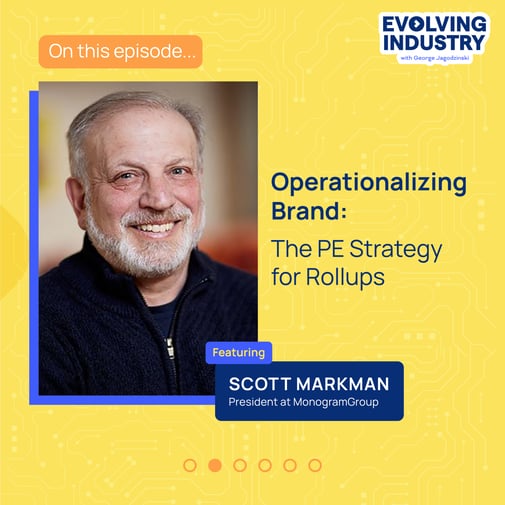
Operationalizing Brand: The PE Strategy for Rollups
After nearly three decades working in private equity, Scott Markman, President at MonogramGroup, has seen the sector grow from a handful of generalist firms to a complex, multi-trillion-dollar industry.
But the core challenge remains the same: how do you unlock massive value in acquired companies?
The answer, Scott argues, lies in operationalizing brand, moving brand strategy from an abstract concept to a structured, measurable engine for growth.
Scott talked with us about:
- The evolution of the operating partner into an essential, full-time role in PE.
- How to reframe the public perception of PE by focusing on middle-market value creation.
- The craft of executing brand strategy during challenging consolidation rollups.
The Rise of the Operating Partner
The private equity landscape is vastly different than it was 30 years ago.
The sheer scale has exploded, and specialization is now required to attract capital.
That’s why Scott noted that today, being a generalist is often considered “a tough sell.”
“ Institutional investors want definition and predictability,” he posited. “[If] I know exactly what I’m going to be investing in… that’s a more concrete, tangible way to [get] a ‘yes’ as opposed to ‘we’re just good investors.’”
This specialization has driven a massive shift in how firms execute deals, resulting in the rise of the operating partner.
Scott explained that prior to about ten years ago, this role “essentially did not exist.”
“ Most firms would have a coterie of people they knew in business or from other PE firms that were a little bit older,” he said. “They [might be] retired, and they were just on side hustles.”
However, Scott said that those roles are now institutionalized.
“It's become easier for us to sell our expertise and our value of deliverables into these companies because there's somebody on the other end who prioritizes and understands it.”
Beyond the “Evil Borg” Narrative
Scott acknowledged the public perception of private equity, which is often framed as a vile entity that is pillaging American businesses.
This narrative focuses on the financial engineering and debt-loading associated with large funds.
However, Scott argued that this perception does not reflect the reality of the middle market where the vast majority of firms operate. He believes the intent in the lower middle market is far more honest.
“They're not really about financial engineering,” he said. “What they do to these companies, the value they create and the benefit that they impart on these companies of which we're a part of, is wildly more positive and common than what The New York Times will talk about.”
Scott talked about how these unsexy businesses are the “backbone of America,” highlighting that when PE firms serve these companies, the value created is more positive than the public narrative suggests.
“It's complex. It's abstract. It's hard to understand, but telling a story about Party City and whoever ruined them and sucked them dry is an easier story to tell.”
Operationalizing Brand in Rollups
Scott opened up about how the ultimate challenge for a firm is transforming a group of successful, founder-led companies, often brought together in a rollup, into a unified, national brand.
These founders are often great engineers or salespeople, but branding is not their core competency.
Scott explained that founder resistance is common when their name is removed from the door, sharing his perspective on overcoming this resistance by offering a clear financial incentive.
“These people are a little bit freaked out at times,” he suggested. “‘You mean my name’s not going to be over the door anymore?’” No, it’s not… But at the end of the day, if someone has $5 million more in [their] pocket... what are you going to say?”
The solution is to operationalize brand by creating a system, not just a logo.
“Operationalizing brand is critical and valuable, but it's hard and a little bit of an unknown to the practitioners on the front lines,” Scott said. “And so, the habit-forming and the training and the coaching to start to play on one team is a big deal in these big roll-ups that are happening all across America right now in a variety of industries.”
Despite the speed bumps, Scott concluded that his satisfaction comes from seeing the impact of his efforts.
“Doing it for the founders and the leaders of these companies and frontline people is even more gratifying because they don't know what they don't know,” he concluded. “And then, what happens is they see our work, and it's like, ‘Oh my God, I just got the keys to a Maserati.’”
Craving more? You can find this interview and many more by subscribing to Evolving Industry on Apple Podcasts, on Spotify, or here.