
Evolving Industry
The Octopus Organization: Building Guardrails for Rogue AI Usage
Is your organization designed to survive in the age of AI?
With the pace of change accelerating, most companies are still designed to defend against known competitors, not adapt to an unknown future.
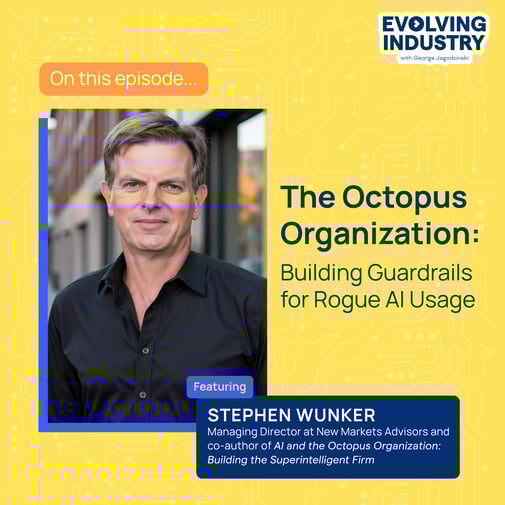
Stephen Wunker, Managing Director at New Markets Advisors and co-author of AI and the Octopus Organization, joined us to unpack this cloudy topic.
Stephen argued that for a company to survive, it must model itself after a creature whose distributed intelligence and ability to edit its own DNA make it the ultimate symbol of adaptation: the octopus.
In this episode of Evolving Industry, Stephen explained why leaders need to move past small efficiency gains to radically rethink their business processes and structure.
Stephen talked with us about:
- The need to aim for process rethink over optimization
- The "Three Hearts" framework for building agility and alignment
- The necessity of empowering rapid, distributed change
From 5% Fixes to 35% Process Rethink
When embarking on a transformation, leaders often make the mistake of focusing on the problems they have today, looking for tools like AI to make their current jobs 5% more efficient.
Stephen argued that this mindset is hazardous, drawing from a powerful lesson that harkened back to his time on a team that created one of the very first smartphones.
They failed not because they thought too small, but because they thought too big and too small at the same time.
“We should have thought about the the on-ramp to changing behavior and not been so captured by our grand visions,” he explained
Instead of being blinded by the possible, leaders need to create the future by finding the right entry point.
Stephen noted that the market often demands the “big sexy device,” like in the early 2000s, but by the time it comes out, market sentiment can shift.
“It's very easy to focus on the problems that we have today and look for tools to solve them,” Stephen explained. “If you're not rethinking the process, rethinking the job, then you're going to get caught flatfooted.”
That strategy starts with building a strong foundation that can survive blips in consumer trends.
”You really need to be designing for the business and not just what the very temporary pressures are calling for.”
The Three Hearts of the Octopus Organization
The octopus organization model suggests that a company needs different operating modes to survive.
“An octopus has three hearts, hearts for different purposes,” Stephen said. “We liken that to a company having different operating modes that it needs to be able to switch among.”
These modes are analytic (for data and measurement), agile (for rapid adaptation), and aligned (for the emotional, human side of change).
The speed of the modern era makes this model mandatory.
“If we think we're in an era of rapid change now, in five years, this is going to feel like the 1950s,” Steve argued. “So we are going to need that agility and adaptation capability.”
He noted that managing change requires clarity. Rapid transformation, if not handled diligently, can kill a business just as easily as doing nothing.
“You will kill the organization if you transform everything all at once. Try and understand what the objective function is. Are we solving for cost or speed? Is it quality?” Steve posited. “Once we can frame the key business issues to solve for, then we can go through and work with execs.”
That conundrum is what led Steve and his co-author, Jonathan Brill, into their deep dive around the fascinating biology of the octopus, to help provide clarity to business leaders who are looking for the “why” behind innovation.
“We need to understand what that transition is, right? If we don't understand what people are going from, we won't have a very clear view about what they're going to and how to help the individuals along the way.”
AI Guardrails and Rapid Rewrites
The octopus’s nine brains and ability to edit its own RNA in a matter of hours is the biological blueprint for organizational change.
Stephen argued that in today’s businesses, this translates to rapid rewrite squads, cross-functional groups empowered by leadership to make changes quickly.
“ If every experimental change in a process or workflow has to go up to some very senior level committee, you're not going to get much done.”
The power must be decentralized, but this also creates the danger of irresponsible AI usage.
“IT shouldn’t be the enemy of innovation, but they should be the enemy of rogue AI,” Stephen said. “ It's happening because people get frustrated and they see so many use cases for AI… Set the guardrails, have veto rights on what goes on through, but enable people to just get on with stuff.”
To manage this, the decentralized data made transparent by AI must be accompanied by human accountability.
“There needs to be some general manager accountability for what's going on,” Stephen explained. “If you have a process for bringing people together… then you can solve [things] in a rapid cycle manner.”
Craving more? You can find this interview and many more by subscribing to Evolving Industry on Apple Podcasts, on Spotify, or here.