
Evolving Industry
Is the app economy on life support?
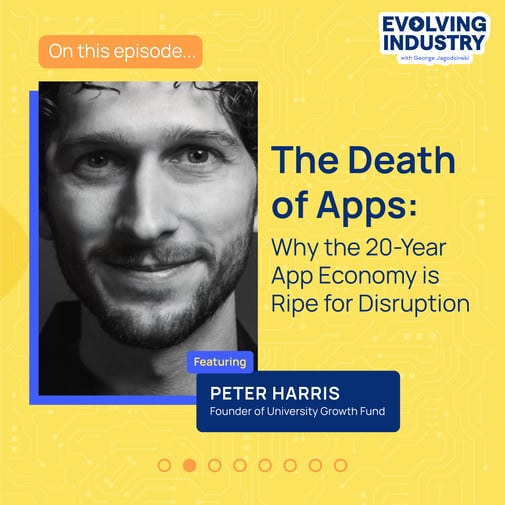
Peter Harris, Founder of University Growth Fund and host of the VC Pete YouTube podcast, believes the rise of agentic AI may be signaling the end of an era.
For the last 20 years, software has been a window into a prescriptive, walled garden of functionality, but that model is officially ripe for change.
The venture capitalist helped us explore the transition from rigid, linear software to a future of hyper-personalized agents and real-world “reps.”
Peter talked with us about:
- Why the traditional SaaS business model is under immediate threat
- The rise of “agent swarms” that bypass legacy walled gardens
- Why experience, not youth, is the ultimate advantage in the AI era
The End of the “80% Perfect” App
Peter observed that the very foundation of the software-as-a-service (SaaS) model is cracking under the pressure of AI-driven development.
Historically, companies built applications to be broad enough to attract a large customer base, which meant they only ever solved about 80% of a user's ideal needs.
“It was too expensive and too hard to build software that got you into that 90, 95, 98% [range] for all of your customers,” he explained. “To build it, maintain it, support it, like all of those things [were] cost-prohibitive.”
To avoid this compromise, Peter highlighted that the cost of entry has dropped so dramatically that a single founder can now build what used to take months of engineering in a single weekend.
This shift creates a paradox: while software is easier to build, the ability for any one application to attract a massive, shared market is effectively dead.
“I can build an application... basically for free,” Peter hammered home. “That [capability] is going to create so many applications that any one application will effectively be dead in terms of its ability to attract a large market”.
Peter warned that if platforms don't shift their monetization strategies, they will be disrupted by this wave of hyper-personalization.
He believes we are moving away from the era of “shared experiences” with apps and toward a world where software is custom-fit for the individual.
Agent Swarms: Bypassing the Walled Garden
One of the most disruptive shifts in the current landscape is what Peter called the rise of “agent swarms.”
For years, users have been forced to navigate multiple “walled garden” apps to complete a single goal, such as switching from a security app to a lighting app to an HVAC app.
He pointed to a future where we no longer interact with the software ourselves, but instead manage agents that do the work for us.
“In a world of AI agents, you could easily have agents that just go out and interact with each of those applications... and then pull the data back together,” Peter argued. “Almost as though you had 10 versions of yourself that were going out and doing the actual work.”
This shift puts legacy giants like Apple and Google in a difficult position.
If an agent can bypass the app interface and go directly to the web to pull what a user needs, the “app toll” begins to lose its relevance.
“I don't know that all of a sudden that matters as much anymore,” he said regarding the traditional revenue split between carriers and app creators. “ I think Apple's got to figure out what that new monetization strategy looks like, as does Google and everybody else. We're already seeing a significant shift in pricing with startups.”
To bridge the gap, companies are already shifting from repeatable SaaS contracts to usage-based models to capture value in this agent-led economy.
Experience: The Ultimate AI Prompt
While Peter is heavily focused on the next generation of talent through his work with the University Growth Fund, he offered a surprising take on the current labor market.
He believes this is the first technology wave where younger people are actually at a disadvantage relative to veterans.
“Older people have more experience, and that experience translates into being able to leverage the models better,” he suggested.
Because AI models are prone to hallucinations, a user needs deep “pattern recognition” to know when a model is going off track.
Without real-world experience, a junior employee might take a model’s output as gospel, leading to critical errors.
“You and I... have enough experience to know when the model is hallucinating,” Peter stated to our host, George Jagodzinski. “If you don't have that experience, you might take what it says on face value”.
Ultimately, Peter believes the future of education and industry must move from “pretend working” to real-world reps.
By creating environments where students and future professionals can get hands-on experience in a safe way, they can level up their “AI prompting game” and stay relevant in a challenging labor market.
The core philosophy of Peter’s approach to both investing and life can be summed up by a guiding principle of compounding value in human-to-human trust.
“When you create a win-win outcome with somebody else, they want to play the game with you again... and the results compound again and again and again over time.”
Craving more? You can find this interview and many more by subscribing to Evolving Industry on Apple Podcasts, on Spotify, or here.