
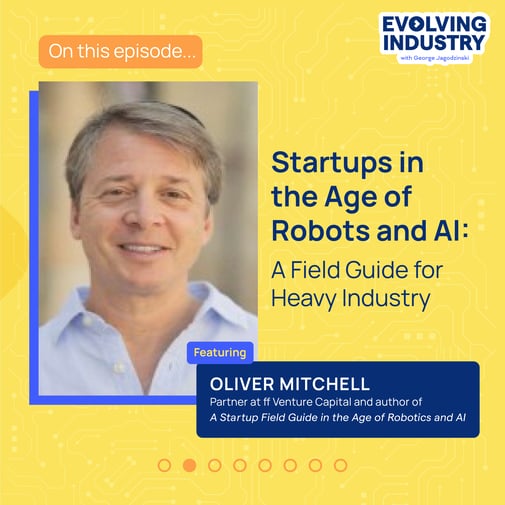
Evolving Industry
Startups in the Age of Robots and AI: A Field Guide for Heavy Industry
In an interconnected world increasingly dominated by digital assets and software-as-a-service, Oliver Mitchell, Partner at ff Venture Capital, is focusing on the “hard things.”
Oliver argued that while scaling a marketplace is relatively straightforward, the robotics and AI sectors require an immense amount of technical and capital support that traditional playbooks often overlook.
The author of A Startup Field Guide in the Age of Robotics and AI helped us explore the transition from “shiny object” technology to mission-critical problem solving in the industrial sector.
Oliver talked with us about:
- Why founders must avoid falling in love with their technology
- The massive “labor void” in heavy industry and the decline of U.S. shipbuilding
- Why humanoids are the “plug and play” solution for modern factories.
The Danger of the Shiny Object
Oliver observed that many leaders treading into the AI space get too enamored with new tools, forgetting why they invested in them in the first place.
“Founders [get] attracted to shiny objects, attracted to the technology,” he explained. “But they never asked, ‘What problem am I really solving?”
To avoid this trap, he advocated for an obsessive approach to customer discovery, suggesting that founders speak to hundreds of potential purchasers before scaling.
“If you do your customer discovery... then you are getting great feedback and you're building that within your feedback loop and evolving your product. If you do that, you're preserving capital.”
Oliver warned founders that falling in love with the tech, rather than user need, is a recipe for failure.
“Really listen to customers. Customers, customers, customers,” he hammered home. “And be obsessive about it… Find out what they want, and build towards that.”
Welders vs. Influencers: The Labor Void
One of the most pressing issues in domestic manufacturing is what Oliver called the “labor void.”
He pointed to a generational shift where potential workers are chasing content creation and niche markets over manual labor.
“People don't want to be welders. People want to be influencers,” Oliver argued. “This new generation would rather sell belts on Etsy.”
This shift has led to a staggering production gap. Mitchell highlighted that while the Brooklyn Navy Yards once built a ship every week, the U.S. produced only a handful of ships last year, while China built hundreds.
“We need hard things built in this country, and our allies do, as well,” he said. “We need to build things in America. For us to outsource it completely to Asia would be a horrible mistake.”
To bridge this gap, Mitchell highlighted entrepreneurs like himself who are building humanoid robots specifically for high-skill labor like welding.
These robots are built for mission-critical, heavy industry tasks that have become increasingly difficult to staff with human workers.
The goal isn't just automation for the sake of it, but filling the more mundane, hazardous roles that are essential for maintaining superpower status.
The Humanoid Advantage: No “Rip and Replace” Required
While Mitchell was once a humanoid (or “human-like” robot) skeptic, he has come to see their value in industrial settings because the world is already built for humans.
Unlike specialized automation that requires a total factory overhaul, he believes humanoids can be integrated into existing infrastructure.
“When you think about dull, dirty, and dangerous [working environments]... that’s where humanoids can be really valuable. And the world is built for humans… You can easily plug and play.”
Since shipyards and factories were designed for the human form, these robots can step into existing workflows seamlessly.
This allows domestic manufacturers to automate without accounting for costs that often stall large-scale modernization efforts.
“The humanoid is a long-term play,” he suggested. “These shipyards are made for humans today, and it's very easy to bring in humanoid welders today.”.
Ultimately, Mitchell believes this technology is a necessity for maintaining global standing and rebuilding the domestic industrial base.
While organizations will need to install new charging stations and fleet management systems, the immediate priority is deploying robots that can operate in the world exactly as it exists right now.
“Robots can do repetitive tasks extremely well,” Oliver stated. “For backbreaking work [and] lifting and roughnecking, robotic humanoids are well-suited. I do think the workflow will change as we implement more of these technologies.”
Craving more? You can find this interview and many more by subscribing to Evolving Industry on Apple Podcasts, on Spotify, or here.
Craving more? You can find this interview and many more by subscribing to Evolving Industry on Apple Podcasts, on Spotify, or here.