Evolving Industry
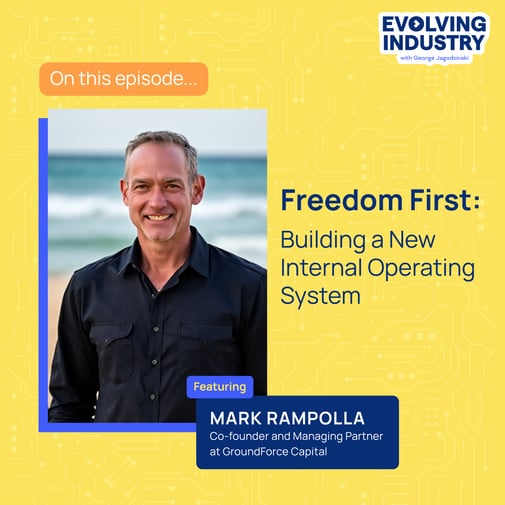
Freedom First: Building a New Internal Operating System
In the high-stakes investment space, what does personal freedom mean to you?
You can sell your company for millions, build a dream home on the coast, and exceed every conventional metric of success… only to find yourself right back in the same mental “grind.”
Mark Rampolla, Co-founder and Managing Partner at GroundForce Capital, realized this truth the hard way.
Despite winning on paper, he found his internal state was still dominated by “noise” and the pressure of what he “should” be doing.
This realization launched a seven-year journey to build a new internal operating system, one that puts freedom first.
In this episode of Evolving Industry, Mark breaks down how to dismantle the traditional grind and align internal success with external accolades.
Mark talked with us about:
- The hidden costs of measuring success on the wrong scorecard
- Shifting from time management to energy management
- Why vulnerability in the boardroom is a competitive advantage
The Hidden Costs of the Wrong Scorecard
Many entrepreneurs believe that financial success is the finish line for stress, but Mark found that without inner work, money actually complicates things.
He discovered that “winning” didn't automatically silence the internal critic or the feeling of being in a constant grind.
Mark recalled waking up to meditate and realizing his mind was “going, going, going” exactly as it had for the previous 30 years.
“I thought that part of [my] success would be true freedom and freedom from this noise,” he admitted. “ I can have the accolades of friends and family in the industry, but am I truly free in my own space to make the choices I want minute to minute, day to day, and without this noise?”
When he took an honest look at his life, he realized he was “the same or worse” than he had been in the depths of running his previous company, ZICO.
“Money alone isn't going to solve this,” Mark suggested. “And in many ways, without doing the inner work, money just complicates it.”
Energy as the Limiting Resource
While most professionals obsess over their calendars, Mark argued that time is not our primary constraint.
“Time is not our limiting resource. It's energy,” Mark argued. “When you dive into something you love, [and] you're passionate about it, you're in your creative energy.”
To combat this deficit, he moved away from focusing strictly on his calendar to focusing on his energy.
One of his primary tactics is an energy audit where he looks at his schedule and asks of each meeting, “Is this an energy up or an energy down?”
He urges leaders to consider the cumulative impact of these choices.
“ It turns out that so many of the meetings I was having were things I believed I should be a part of,” Mark explained. “And I started asking myself, ‘Am I certain? Am I absolutely certain that's true?’”
The ROI of Vulnerability
One of the most radical shifts in Mark’s operating system is the move toward vulnerability and radical candor.
He believes it creates an efficient culture where “rogue” emotions don't slow down business results.
“When I can [take] a hundred percent responsibility for myself and somebody else takes a hundred percent responsibility for [their actions]... then we create a space where we all get to learn and get to the balanced outcome.”
This philosophy was put to the test during a months-long boardroom stalemate that was only broken when Mark stopped and admitted the unthinkable.
“I stopped and said, ‘I don't know what to do,’” he admitted. “And the room went silent.”
While the initial shock gave Mark and his fellow board members pause, he said that exposure to their uncertain reality was exactly what they needed.
“We walked out of that meeting not knowing what to do, but that was the most powerful reset because it allowed us to say, ‘Okay, how do we figure out what to do?’” he recalled. “We stopped, we looked, we listened, and we went through a rigorous process. [As a result], that company grew 40% last year.”
Ultimately, Mark views this level of vulnerability as a valuable strategic tool.
“I feel like I can be most helpful to others by being vulnerable… When you’re aware of your [shortcomings], share them with others. Then you can help each other fill those blind spots and get the best results.”
Craving more? You can find this interview and many more by subscribing to Evolving Industry on Apple Podcasts, on Spotify, or here.
Craving more? You can find this interview and many more by subscribing to Evolving Industry on Apple Podcasts, on Spotify, or here.