
Evolving Industry
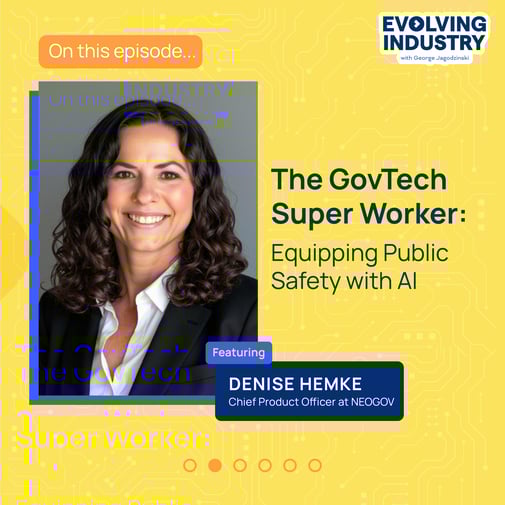
The GovTech Super Worker: Equipping Public Safety with AI
After a career spanning major commercial brands like AT&T and Salesforce, Denise Hemke, Chief Product Officer at NEOGOV, made a pivot to the public sector driven by a powerful mission: “serve the people who serve the people.”
In this episode of Evolving Industry, Denise explained why the perception of government as a “laggard market” is often wrong.
She argued that GovTech customers are uniquely collaborative and eager to share data, creating a massive opportunity to leverage AI and data to drive efficiency and safety.
Denise talked with us about:
- The unique collaborative culture of government work
- Creating the public sector “super worker” with AI
- The shift in product development toward judgment and rapid prototyping
The Unique Collaboration of GovTech
Denise notes that moving from the private sector to GovTech was an eye-opening experience, particularly due to the fundamental difference in customer relationships.
Unlike commercial rivals who hoard data and competitive secrets, government agencies are inherently collaborative.
“They're not competitive with one another,” Denise explained. “ They're not holding back. There are no trade secrets.”
This willingness to share is a “magical gift” that accelerates innovation, especially in data-intensive areas like hiring.
This collaboration allows small agencies access to resources and best practices they might not otherwise have.
“If you go back to the private sector, no company is going to disclose that data to their competitor... but in government? They want to raise the tide for everyone.”
AI as a Super Skill: Reinforcing Policy for Split-Second Decisions
The core of NEOGOV's strategy is turning every government employee into a “super worker” by equipping them with super skills through AI.
Denise said that this strategy is already playing out in critical areas like HR for filling lower-performing roles.
“If you look at those highest performing jobs, they're the ones that are getting more [applications], but that's not who needs people, right?” Denise argued. “Do you know a traffic light engineer? People are hard to find.”
For human resources, AI is leveraged for smarter job recommendations, helping agencies fill hard-to-find roles. This works by showing recruiters how other agencies are succeeding.
“If we surface to you through that smart job recommendation that if you lower the degree requirement from a four-year degree to a two-year degree, then you’re likely to get more applicants,” Denise said. “Those are the types of things that turn [a] recruiter into a super worker.”
Denise also mentioned their AI-driven Recall product that uses digital flashcards and repetition to ensure officers and 911 operators have critical policy knowledge top-of-mind.
“It’s like your braces, right?” Denise opined. “You still might need to do that annual training, but if you don’t wear the retainer... then you’re not going to have perfectly straight teeth. And so, this is really great reinforcement learning on a continuous basis.”
The Future of Product: Judgment Over Features
As a Chief Product Officer, Denise noted that AI is fundamentally changing the product roadmap.
It’s easier than ever to build features (writing user stories, release notes, etc.), but that doesn’t mean the features are the right ones.
“I think one of the challenges when it comes to roadmap [is] anybody can list out a bunch of features... But are we building the right set of features?” Denise asked.
She argued that in this AI-centric environment, critical thinking is more vital than ever.
“I think judgment becomes more and more critical in this world of AI because it will become easier and easier to just push out more, and more is not always better.”
The solution? Embracing tools like rapid prototyping.
“People really [need] this opportunity to touch and feel the system,” Denise explained. “They know they've got this problem, but they're not always clear [if what they’re] building is going to help solve their need.”
This tactic allows her team to quickly prompt their way to functional mock-ups that customers can test for themselves before fully committing to the product.
“This is a really powerful tool,” Denise outlined. “We can prototype it, we can launch it, and we can do that in a rapid way that really helps customers get what they need.”
Ultimately, this mission-driven approach informs their entire product strategy, but it’s their passion for people that is the beating heart of their organization.
Denise was able to speak from personal experience on that note, citing her brother-in-law who serves in law enforcement.
“ It is near and dear to my heart how much work it is to be in these types of jobs,” Denise said in closing. “I'm serving their families and I'm serving their communities. And so, that's where that [passion] comes from for me, personally.”
Craving more? You can find this interview and many more by subscribing to Evolving Industry on Apple Podcasts, on Spotify, or here.
Craving more? You can find this interview and many more by subscribing to Evolving Industry on Apple Podcasts, on Spotify, or here.